Author: by Lilla Burányi Virág, supervisor: Dr. Zsolt Biró
In the autumn of 2023, I won a grant from the Fauna and Flora Foundation to add nine wildlife cameras to my research on the wild cat (Felis silvestris) in the Visegrad Mountains. A summary of the first results can be found here: https://faunaesflora.com/2024/08/07/vadmacska-kameracsapdas-es-kerdoives-felmerese-a-pilis-budai-hegysegben/. Fortunately, with the help of the Foundation, I was able to continue this work, as I resubmitted my application in spring 2024, which was positively evaluated. I was particularly happy about this, as at the beginning of 2025 I was accepted to the Doctoral School of Animal Biotechnology and Animal Sciences at the Hungarian University of Agricultural and Life Sciences, and with the help of the Foundation I was able to continue my camera trapping study that I had started earlier. My current report covers the year 2024, focusing on the felids (feral cats, domestic cats) observed by camera traps.
The feral cat (Felis silvestris) (see Figure 1) is protected worldwide, but there are countries - such as Hungary - where numbers are alarmingly low and in constant decline. The main threats to feral cats are anthropogenic: habitat fragmentation and degradation, illegal hunting, road killings, declining populations of prey animals, competition with domestic cats (Felis catus) (see Figure 2), and the risk of potentially communicable diseases and hybridisation with them. The mixing of the two species is causing the genetic stock of the wild cat to degrade to the point where, when mixed with all the other threat components, it may even be on the verge of extinction in the wild in Hungary. Due to its hidden lifestyle, avoidance of humans and small numbers, the wildcat is a difficult to study and least studied predator in Central Europe. Unfortunately, there is still insufficient information on the exact size, distribution and land use of the feral cat population in our country. In my thesis I wanted to find solutions to these problems. My objectives were to continue the work started earlier and to explore the question "Do feral cats live near the capital, in the area of the Pilis Park Forest Ltd.?" According to my previous hypothesis, the individuals (feral cats, domestic cats and their hybrids) seen in camera trap photos can be identified by fur pattern, species level and individual level.


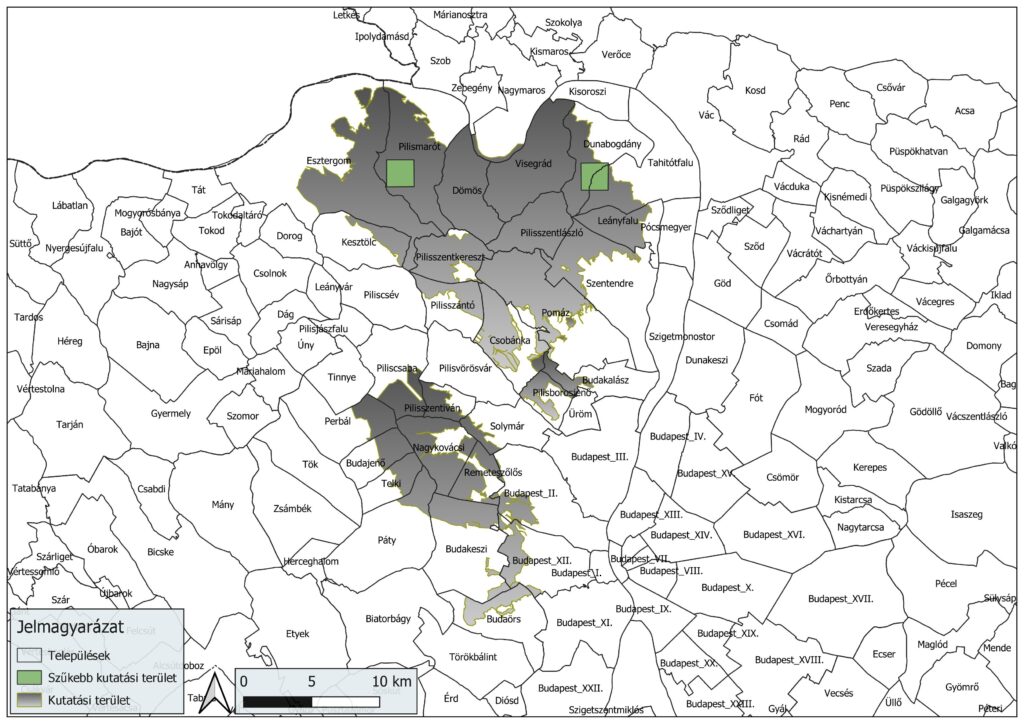
My field research was carried out in the Visegrad Mountains, where I conducted gridded camera trap surveys in two areas (Tahitótfalun - 8 cameras, Pilismarót - 9 cameras) from January to December 2024 (see Figure 3). My research was supported by the Fauna and Flora Foundation with 9 wildlife cameras, so I was able to observe felid behaviour in Pilismaró in addition to Tahitótfalu. In addition, I was able to carry out camera trap checks with the support of the Foundation.
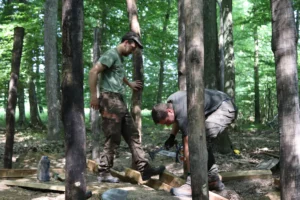
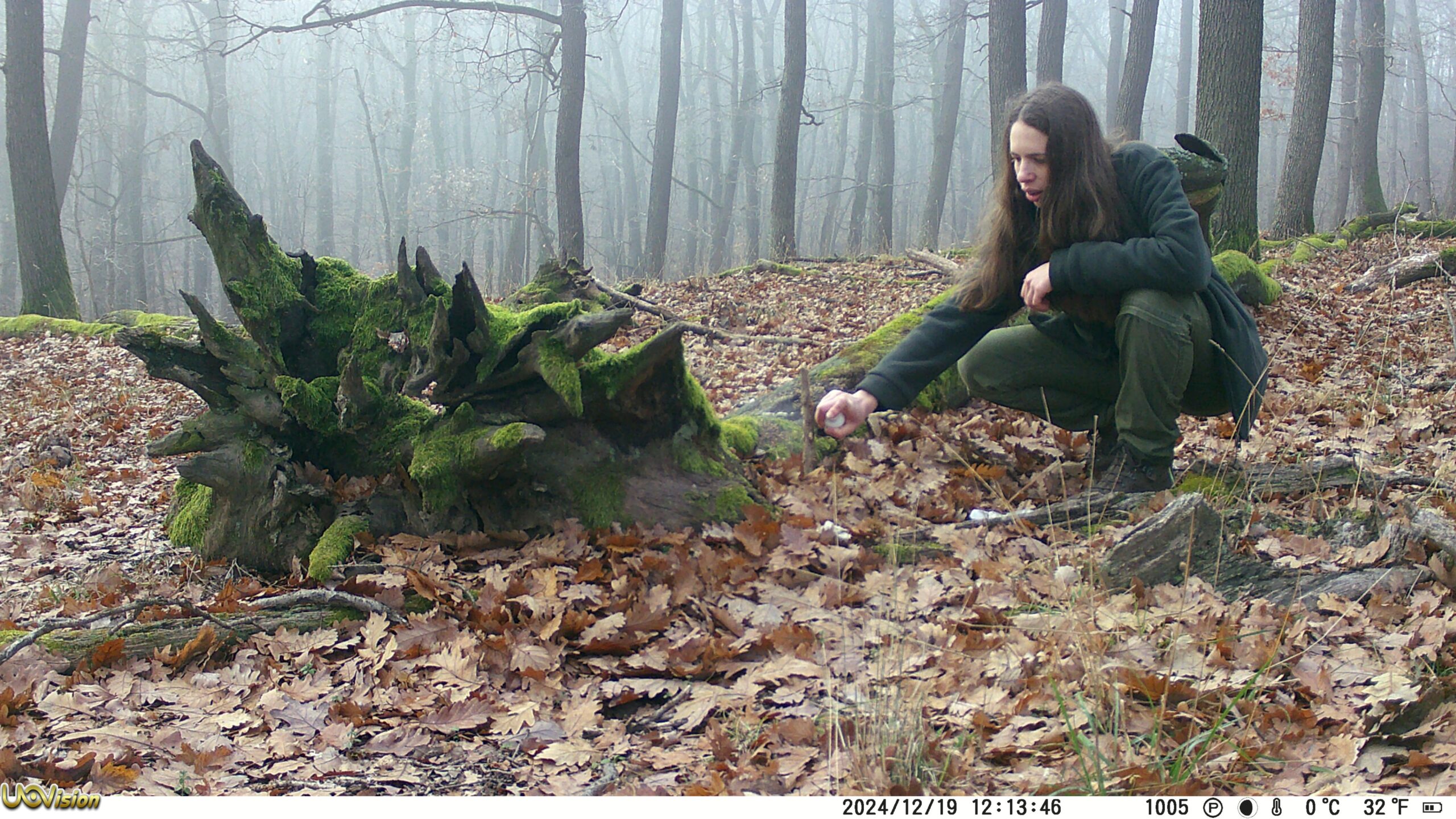
My aim was to use the camera traps to get a picture of the occurrence of feral and domestic cats and their hybrids. In addition to the feral cameras, I used various attractants (catnip, catnip root) and decoys (oily fish), which have been used successfully in the literature, placed next to the hair collection stake. I checked the camera traps on a monthly (sometimes bi-monthly) basis, updated the attractant and bait materials (see Figure 4), replaced missing hair collectors, and replaced memory cards and batteries in the cameras when necessary. I kept a log for each camera, updated it continuously and recorded any cat sightings. I sorted through all the photos taken with the wildlife cameras (ignoring those that did not contain the animal) and sorted the target species - feral cat, domestic cat, their hybrid - into separate folders.
Whenever possible, I tried to identify the cats individually, based on their coat pattern. For species-level identification - feral or domestic cat or possibly a hybrid of both - I used the morphological stamp classification system developed by Kitchener et al. I also separated out the photographs that did not contain any animals ('bad'), so that I ended up comparing the appearance of cats with that of all other mammal species (wild boar, roe deer, deer, mouflon, badger, fox, jackal, marten, rabbit, brown hare, squirrel, pele, dog). The centre of the wildlife cameras in Tahitótfalu was the DINPI/1 camera at the meadow of Nádasto - 2.7 km west of the nearest edge of the settlement - where camera trap photos of wild cats had been taken in previous years. A quadrat system of 8 camera points was assigned to this central camera, where it was planned to place the cameras 1 km apart, covering 400 hectares of forest area. This area delineation was based on a literature review that found the domestic range of movement for males to be 491-872 ha, Biró 2004 found it to average 515 ha (and the core area 132.86 ha); while that of females was 172-384 ha, Biró found it to average 397.7 ha (and the core area 59.62 ha). While Lanszki, citing previous national radio-telemetry studies, puts the adult feral cat's range at 100-900 ha, the size of which is influenced by various resources (e.g. food, water, shelter). Unfortunately, I only had 7 cameras available, so I ended up placing the cameras in the locations indicated by the red dots and the serial numbers of the cameras (BKVP/2, BKVP/3, etc.) as shown in Figure 5.
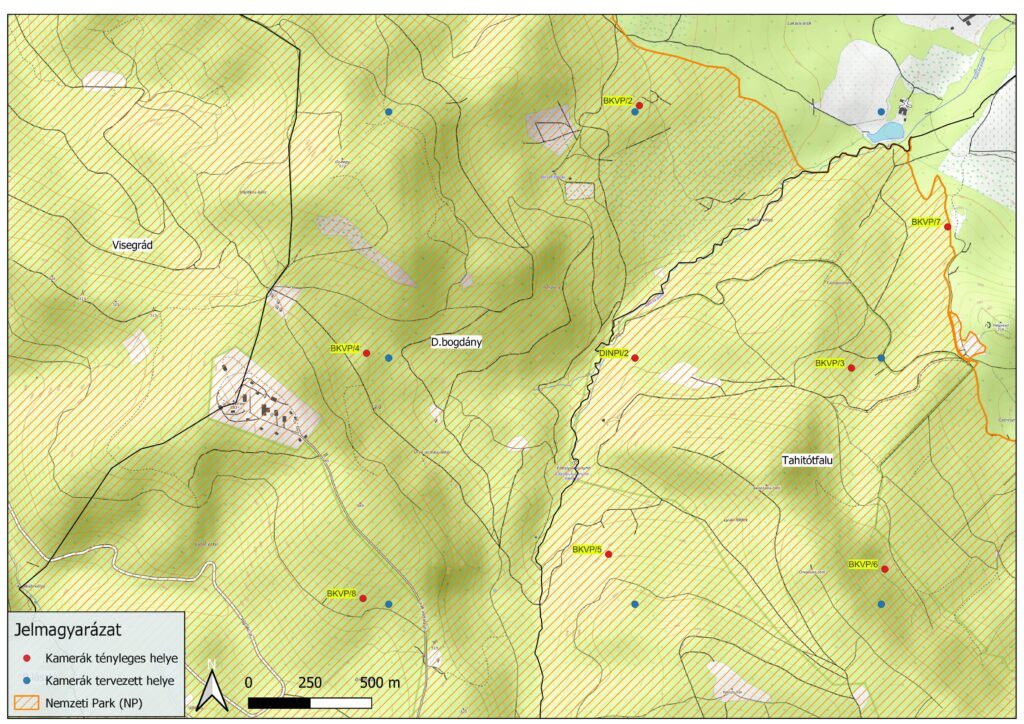
(red dots) (Source: DINPI/Novák, 2024)
In Pilismaró, I followed a similar principle, with additional cameras (BKVP/9, BKVP/10, etc.) marked 1 km apart from the central camera in the quadratic system, with blue dots indicating the planned location and red dots and camera numbers (BKVP/9, BKVP/10, etc.) indicate the actual location of the cameras (see Figure 6). The nearest edge of the settlement to the central camera is 3.2 km to the southwest.
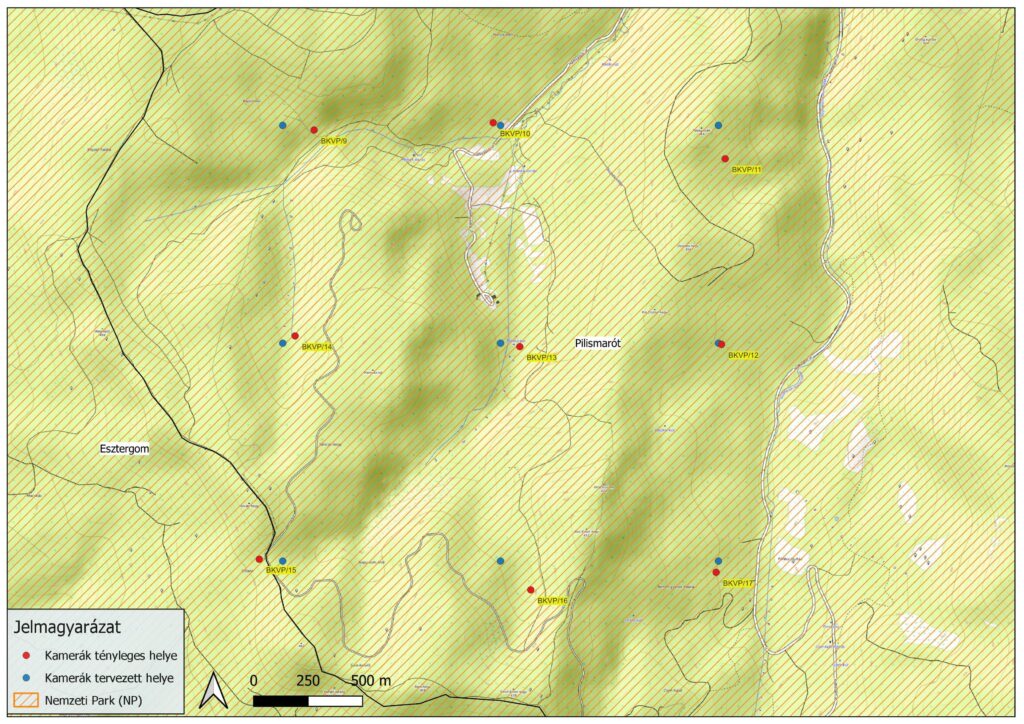
(red dots), (Source: DINPI/Novák, 2024)
Between 2024.01.01. and 2024.12.31., I launched the 7 and 9 camera traps in Tahitótfalun 78 times and in Pilismaró 133 times. Unfortunately, the camera trap failed 5 times in Tahitótfalun. A total of 7 (27 photos) feral cats were detected in Tahitótfalun, no domestic cats were detected (Figure 7). On the other hand, in Pilismaró, a total of 21 feral cat sightings (534 photos) and 3 domestic cat sightings (40 photos) were recorded (Figure 7). I counted as a single sighting photos taken within 10 minutes, and as multiple sightings if more than 10 minutes elapsed between two cat photos. Unfortunately, in many cases I found that very blurry images of the animals were captured, so I could not always determine whether the same feral cat was seen over and over again in the images or whether several different feral cats were captured.

In Tahitótfalun, 3 out of 7 cameras (camera traps BKVP/2, BKVP/4, BKVP/8) detected the presence of wild cats. In Pilismaró, 5 out of 9 cameras (camera traps BKVP/9, BKVP/10, BKVP/13, BKVP/14, BKVP/15) detected the presence of wild cats. There was one site in Tahito village - camera BKVP/8 - that photographed feral cats more than once. While in Pilismaró, there were 5 sites - BKVP cameras 9, 10, 13, 14, 15 - which photographed feral cats more than once. In Tahito village, there were 0.29 feral cat sightings per 100 camera trap nights and 0 house cat sightings; while in Pilismarote, there were 0.61 feral cat sightings per 100 camera trap nights and 0.09 house cat sightings (see Table 1).
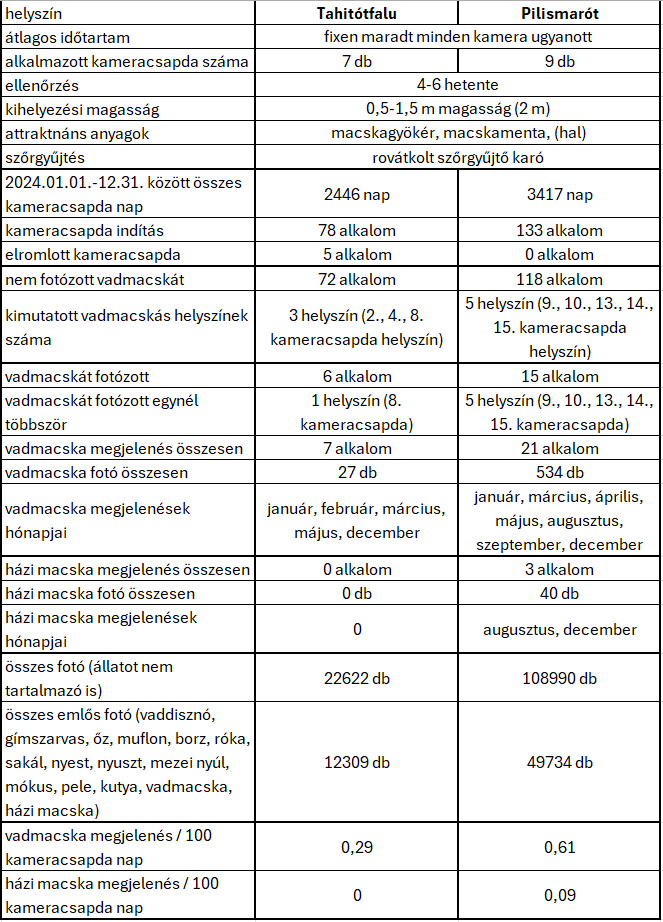
Based on my camera trap investigation, it has been proven that there are feral cats living near the capital, in the area of the Pilis Park Forest Ltd. However, my hypothesis that the individuals (feral cats, domestic cats and their hybrids) seen in the camera trap photos can be identified by fur pattern, species level and individual level, did not prove feasible in all cases. I was particularly pleased to have had the pleasure of photographing a mother wildcat with her three kittens with the BKVP/15 camera in Pilismaróti, but I find it worrying that a white-fronted domestic cat appeared a month earlier with the same camera. I think that in the future it would be worthwhile to use more night-time colour blind wildlife cameras with a response time of less than 0.5 seconds to get more usable footage of cats.